
No products in the cart.

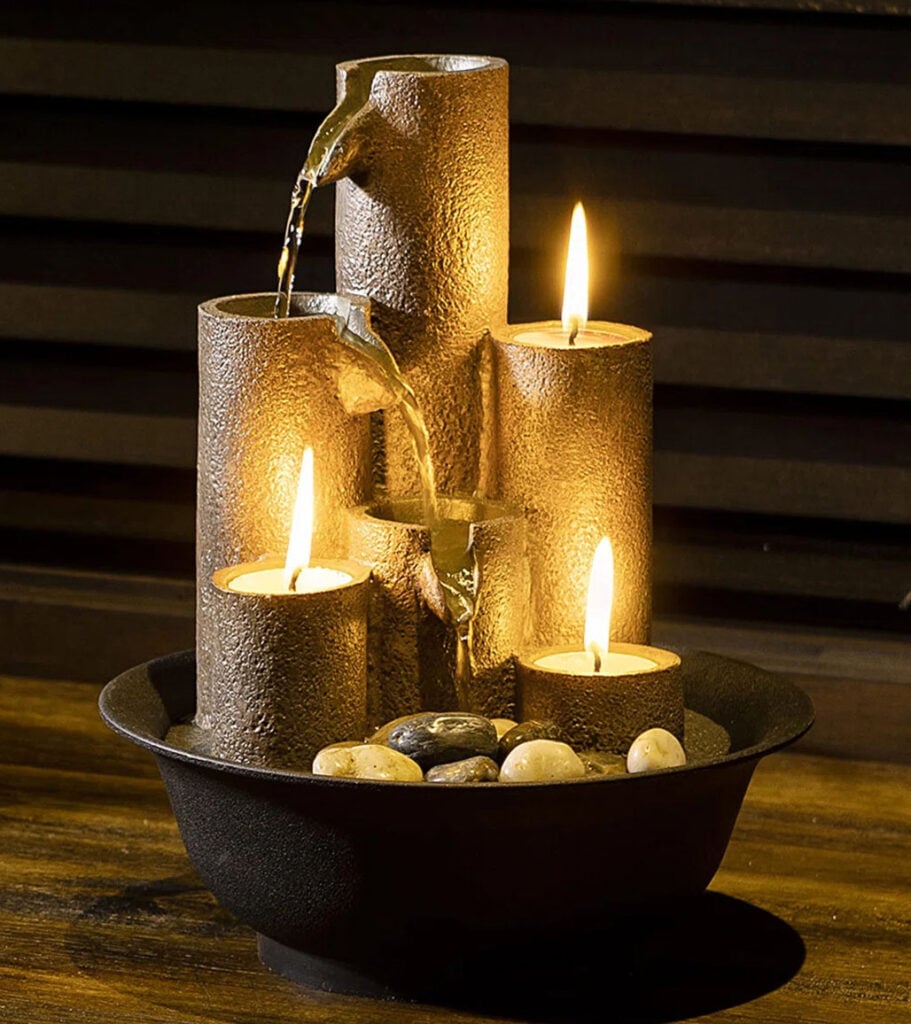
Many of us look for ways to improve our home and surroundings, to make them more attractive and enjoyable, without going through a lot of trouble or expense. Indoor fountains are an extremely effective way to achieve this – with caveats. Unless you’ve spent some time working with indoor fountains it is likely you won’t be aware of their potential pitfalls. Here we discuss what to look for, and what to look out for in acquiring and placing small indoor water fountains in your home or office. Basically there are three areas of concern: Practicality, Beauty and Quality.
Practicality means that your fountain mustn’t give you a lot of trouble in set-up or to maintain because if it fails here you will end up not using it. Also to consider are the sounds it makes. Water falling into water can be a delightful sound but too much of it, which is subjective, will make you want to not run it. Check if the seller states the dB (decibel) level of the fountain and if the pump is adjustable.
Beauty refers to the visual and aural appeal of the fountain, which can vary enormously, is in part subjective, and is the primary reason for having one.
Quality refers to how and of what the indoor fountain is made. If it is poorly made or made of cheap, synthetic materials it will not bring you the satisfaction you seek and though intriguing at first, ultimately you will discard it. High quality products tend to remain in use – poor quality products are quickly discarded, either because they lose their value to the owner or they deteriorate.
The attractiveness of the three indoor fountains presented here is, for this writer, mitigated by knowing that they are made of plastic. They most certainly have aesthetic appeal but the reality of what they actually are ruins that. Not necessarily because they are ‘pretending’ to be something they are not – we at ThirstyCats make various forms, such as leaves and flowers, from ceramics so they too are not what they are representing, however clay has been a building material used for countless forms for many thousands of years and is a time-honored material for the creation of many art objects. Plastic does not have those credentials and likely never will, particularly knowing the health hazards of handling and even just being around plastic.
Let’s begin with the practicality of this six column fountain, (which is made of resin (read plastic)), setup and maintenance are not particularly difficult. The columns assembly is all of a piece and lifts out to access the pump and for cleaning.
It is universally advised that no objects made of resin should be put even into the top shelf of the dishwasher as so doing will cause them to soften, warp and deform and can also begin to release toxic materials.
So, it will need to be washed by hand, which isn’t in itself a major task so long as you are careful to clean very well where the water is held and flows as these areas will tend to develop biofilm (slime) and possibly mold. You may need a cleaning agent, such as bleach, for those areas.
Many resin-made indoor fountains come with pebbles, used to hide the pump or other functional parts. You will need to remove these, (the only natural portion of this fountain), for cleaning beneath them and you should clean the pebbles too.
This is a relatively quiet fountain though with three streams there will be water sounds, but as they are small streams this should not be too great. Specifications for dB and if the pump is adjustable are not given.
Concerning beauty, many will find this indoor fountain to be quite attractive, as would this writer if not for the rather sterile perfection of the form, a consequence of it being made in a mold and not by hand, and for the material of which it is made. Many indoor fountains come with places for candles. The fire and water make a wonderful contrast and that has its appeal. You would not want the candles lit if there are any children or animals that can access it.
Placement can be on any medium to large table or otherwise elevated surface that cannot be accessed by children when the candles are lit, or by pets anytime as this is not a food-safe material. It would look best from about five feet to fifteen feet from where it will be most seen.
As to the quality of this fountain, the molds for its making would seem to be well made so the pieces (bowl and columns) that come out of them are probably nearly flawless. Is this high quality? For what it is, a fountain made of resin, it would seem so but you to must decide for yourself. How long it will last is by this writer not known.
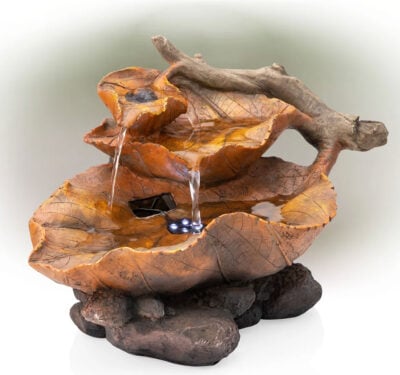
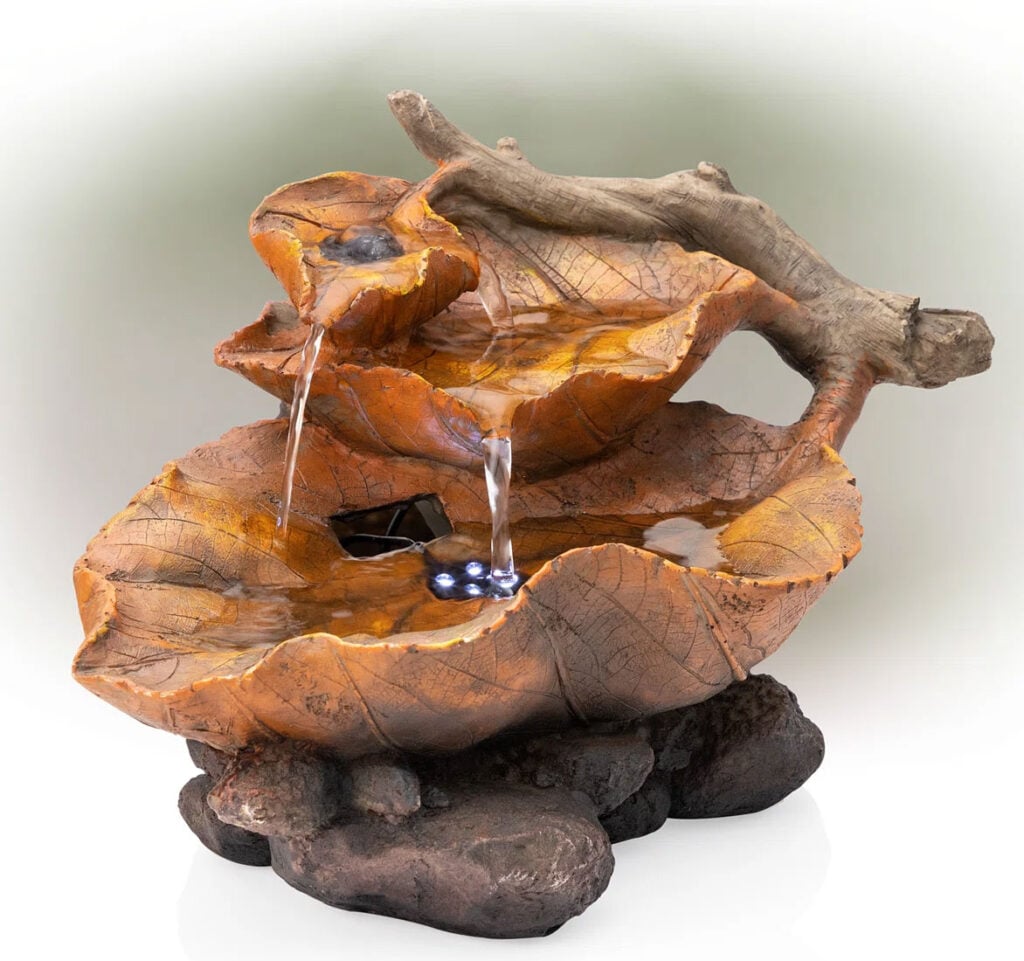
Concerning practicality for the second fountain with the branch and leaves the setup is a bit tricky but you can pay an additional $79 to have it setup for you. The seller advises that the paint on this fountain will wear where the water is and suggests you can repaint it when that occurs – a bit of a challenge to get that right we should think. Because paint is toxic no animal should drink from this fountain.
So setup is a bit of trouble it seems but maintenance shouldn’t be too difficult if the painted surface doesn’t develop bacterial mold (biofilm). Repainting would not need to be too frequent.
Water sounds will be low with this fountain. Decibel level and if the pump is adjustable are not stated by the sellerss.
The design of this indoor fountain this writer finds to be quite lovely, or would, were it not made of fiberglass which is glass filaments soaked in a plastic resin and in this case, painted over with ordinary paint. The over-obvious lights and battery in the bottom leaf are also severely distracting and seriously reduce the aesthetic value of the piece by violating the unity of composition (a principle of aesthetics). It might be possible to camouflage the battery and possibly the lights with some other natural components such as a branch or small glass leaves and still have the lights show.
Placement can be on any medium to large table or otherwise elevated surface that cannot be accessed by pets and if the lights and battery are camouflaged, is best seen up close or from about ten feet distant.
The piece would seem to be well made. It is a quality piece of fiberglass construction. Had the colorants been incorporated into the resin it would have been of higher quality. The paint reduces both the beauty and practicality of the fountain. So long as you remain comfortable with fiberglass as a material for an object d’art and you don’t mind repainting it once in a while it is a good indoor fountain.
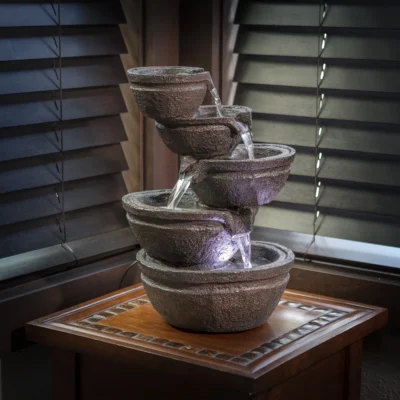
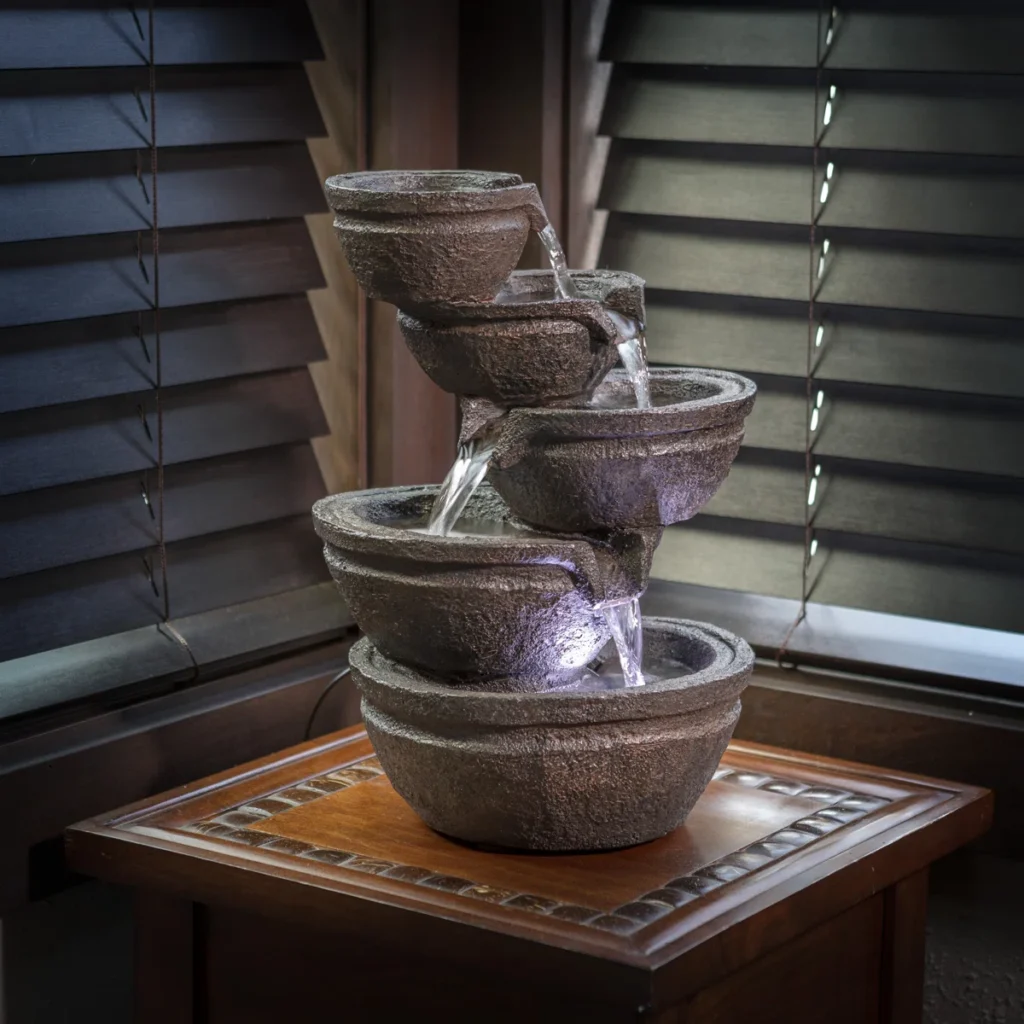
The third indoor fountain is also made of fiberglass, resin and paint, imitating carved stone. This fountain too can be set up for you for a price. It stands nearly two feet tall and weighs nearly twenty pounds, which limits its usefulness for some. Smaller versions are probably available.
The pump is in the bottom basin, pumping water up through a tube. All the basins will need thorough cleaning to prevent biofilm, or various mold-reducing agents can be added to the water. (Not for pets.)
Water sounds will be considerable with this indoor fountain though decibel level and if the pump is adjustable are not stated.
The visual appeal is the cascade of water from tier to tier which almost everyone enjoys, and for some, the lights which illuminate the water. As with the other two and all these types of fountains it is mold-made and completely synthetic. If you are comfortable with that then this is a viable solution for dressing up an area of your home.
The great advantage of mold-made is that once you get the mold right, all the pieces that come out of it will be right, with minor exceptions due to anomalies in production. Some people like this, others prefer the ‘Wabi Sabi‘ that is often an aspect of hand-made creations. So this piece is of good quality for what it is.
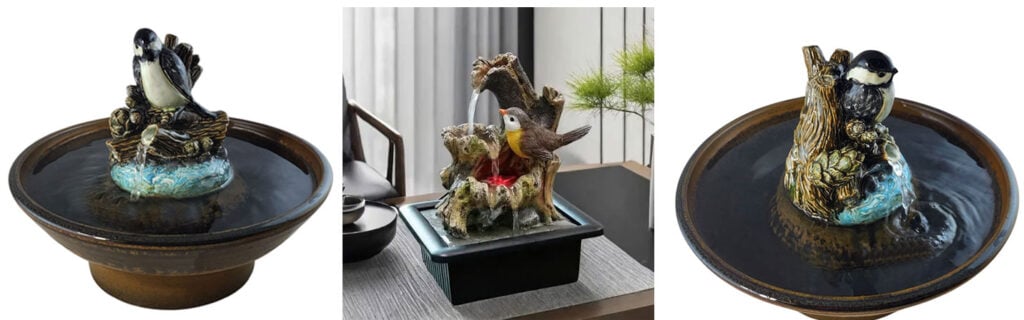
There may not be much difference in the outward appearance of a synthetic indoor fountain made in a mold and a natural-material fountain made completely by hand, which is why for many, the considerable price difference between the two does not warrant buying the hand-made.
In the image above the central fountain is mold-made of resin with the two pieces – the bowl, and the bird and branch arrangement, cast separately, then combined. Made of resin it is not suitable for pets but can make a pretty home decor item if the the material it is made from is acceptable to you. It will probably develop biofilm unless some additive to the water is used, cleaning must be thorough.
The other two images show a Chickadee indoor fountain. It was sculpted completely by hand of high-fire ceramics, hand-painted with glazes (not paint) and fired in the kiln to about 2200°. (The entire piece is glazed – meaning the colorants of the fountain have penetrated into the clay and are a part of it. They can’t wear.)
The Chickadee setting sits in the handmade (thrown on the wheel) bowl and is lifted out for cleankng. Made of ceramics it does not develop biofilm and cleaning takes about five minutes once a week if being used by a cat, once every two or three weeks if not.
Though the appearance of these indoor fountains may be similar there is no comparison between either their price or their quality. The chickadee infoor fountain costs about five times the resin made fountain, which was easily and inexpensively made of synthetic materials with no handmade element to it. It could not be called a work of art but a work of technology and can be, and is, repeated endlessly without variation. Many people can have this fountain.
The Chickadee indoor fountain is completely handmade and is a piece of Ceramic Art as well as a cat drinking fountain. Though the design can be repeated the work is itself completely unique and cannot be reproduced. It will always be the only one of its kind. No other will be just like it. Whoever owns this fountain will be the only person to have it.
Is it worth the price difference? This is for each to decide and your answer to this question may not be your neighbors’ answer.
Decibel level and pump adjustablity are not given for the resin fountain. The Chickadee fountain states the decibel level (8) which is very quiet, and the pumps in all this brands (Thirstycatfountains) are adjustable.
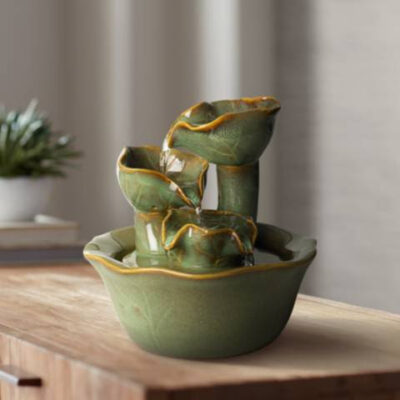
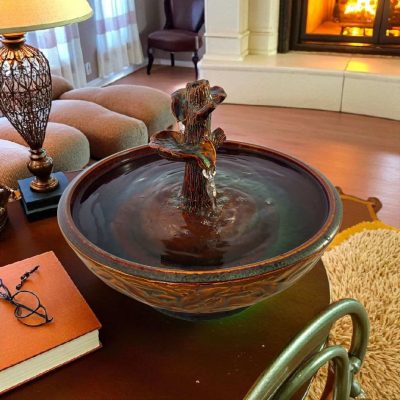
Presented here are two ceramic fountains, the one on the left made in a mold of lowfire clay and glazes, the other completely hand-built of high-fire clay and glazes. Similar in style with cascading streams, the only apparent differences are in form and glaze.
What are the non-apparant differences? Are there any which have a bearing on their practicality, beauty and quality?
With both fountains the center piece which is over the pump lifts out for maintenance and both fountains are relatively easy to clean. Although both are ceramic, the mold-made on the left is of low density clay and low fire glazes. Does this matter? Maybe. The durability of the mold-made piece may be less than that of the handmade as it is made of a more porous, lighter weight clay. Being low-fire, the glaze too may be less reliable and biofilm will be an issue.
The real difference though, between these two indoor fountains is that the one on the left is one of hundreds or thousands as it was cast in a mold and each casting is identical to the other. No individual effort or skill went into its creation. It is not a work of art, it is a work of technology.
The fountain on the right was made completely by hand from the throwing of the bowl, applying slip (wet clay) to the thrown bowl for textural ornamentation (go here to see this fountain in more detail), to the sculpting of the Brackentree center piece.
Although this basic (Brackentree) design is repeated, this particular fountain with all its variables (glaze color and variations, specific shape, water flow, etc.) is unique. There is and will ever be only one – this one.
The skills required to make the handmade fountain took over ten years to develop. Its creation required both well-honed abilities as well as well developed artistry and it is this which elevates this fountain above the mold-made. It is a unique work of art as well as a practically functioning indoor fountaion and a fountan for cats. It was built by artisans, not machines and is imbued with the quality of attention and applied skill. Does this warrant it costing three or more times the mold-made? For some, no. For others, there isn’t even any real comparison.