
No products in the cart.
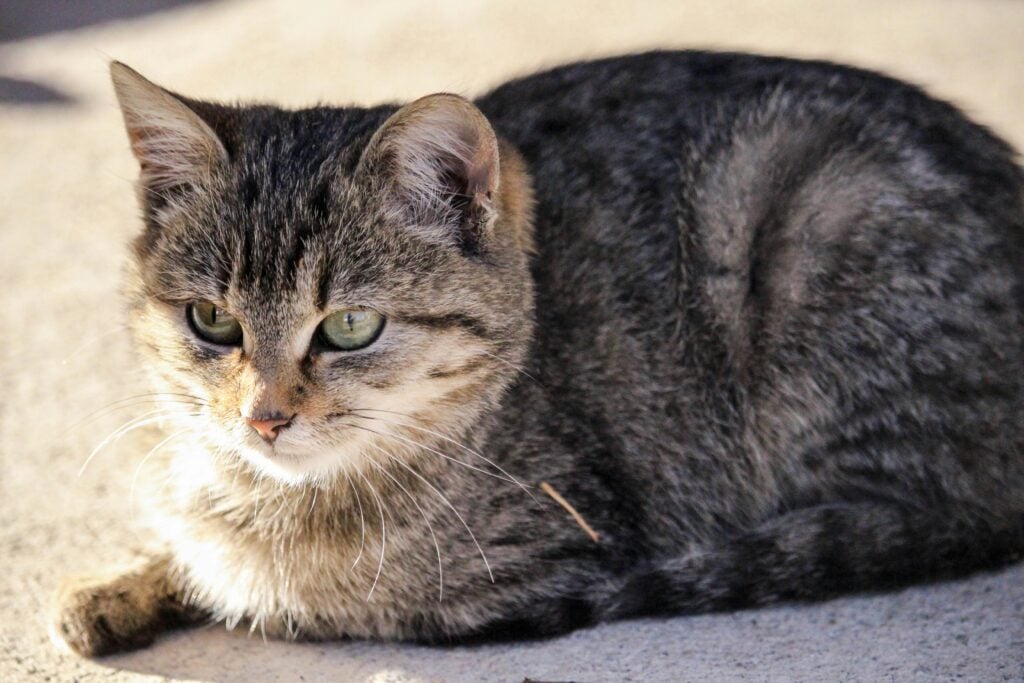
Cats communicate primarily through body language rather than sound. Subtle signals like slow blinking, tail position, ear movement, and stillness all convey emotion and intent – their current relationship to whatever is happening around them.
Learning to recognize these quiet behaviors helps us better understand our cat’s comfort level, trust, mood and desires.
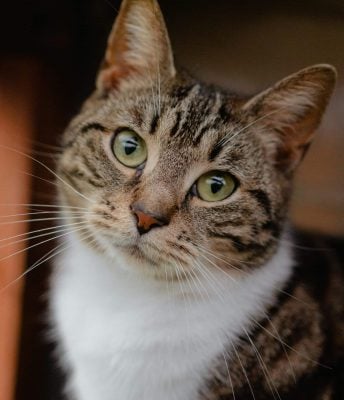
Very often when cats are completely silent they are communicating something quite specific, and actually expecting us to ‘hear’ them. Another cat would know what the silent cat is saying, and we can learn to also, to a degree.
A slow blink from across the room; a tail resting gently around their paws; the slight turn of an ear. These are signals—not habits.
A slow blink is often called a “cat kiss,” but more accurately, it’s a sign of ease and an intentional statement of non-aggression. A cat who blinks slowly isn’t preparing to react—they are saying “I’m cool. So are you.”
When two cats are confronting one another the most aggressive will try to stare down the other. It is a pronounced act of aggression and meant to intimidate. Blinking is the opposite.This is why we are often advised by cat behaviorists when dealing with a frightened cat to enact this gesture – blink slowly and don’t stare.
Tail posture adds another layer. A relaxed, upright tail signals assurance. The cat is at ease and not expecting any trouble. A softly swaying tail suggests a slightly greaeter degree of contentment. A flicking tip often means something has interrupted their calm and the cat is considering or mentally weighing something. This will resolve by the cat taking some definite action, such as pouncing on something, or it will relax back to an upright and or swaying position.
Even stillness communicates. A cat choosing to sit quietly near you is making a decision to share space.

Not only because these are subtle communications do we tend to miss them but as well because it is a different language cats use that we can learn to read but only with exposure to them, over time.
Everyone who lives with a cat knows this and most people do come to understand what their cat is ‘saying’, at least some of the time. What might be considered outstanding in all this is that cats very often want to communicate with us and they actually try to make themselves understood. The more we are able to read cat language the closer our bond with them becomes.
It can be helpful in this endeavor to watch cats together, if that is an option. The response of one cat to the action of another reveals the intent of the action.
For example, if a cat hisses at another cat, both the intent of the hissing cat and the reaction of the other are pretty clear. But there are many other more subtle expressions, often not even vocal. The physical orientation one cat takes in the presence of another will usually illicit a response, as it is intended to.
For example, if one cat approaches another and the one being approached turns slightly sideways we will often see the approaching cat stop, having just been told (sort of), “I’m not interested, I don’t want to be with you right now”, or even, “I don’t like you, go away.”
The key here is to realize that the result of an action (or inaction) reveals the intent – demonstrating what the cat is communicating. But is is not quite like; “I don’t want him coming near so I’ll give him the cold shoulder.” That would be a pretty anthropomorphic understanding. Cats behave the way they feel. It’s not like they have a repetoire of behaviors, like taking up a physical position to communicate something. They take a physical position because they feel something and they naturally express what that feeling evokes in them by particular behavior.
So in the example above, the cat being approached feels a distaste for interaction at that moment – he simply does not want the other cat to come near, perhaps he doesn’t feel well – whatever, and he shows it in his response to the approach of the other cat, who in his turn, feels that response because if he felt that way that is that is what he would do.
Communication is a two way street, as we all know. Communication implies expression and reception and without both, it dosn’t happen. Which is why cats can be frustrated with us when they are expressing and we are not receiving. Learning Cat, then, is not only fascinating, it is really useful when cats are part of our life.
Here is a video about the Cats’ Silent Meow